
The First Clinician to Respond Usually Gets the Client: Automated Follow-Up Emails for Private Pay Practices
The First Clinician to Respond Usually Gets the Client: Automated Follow-Up Emails for Private Pay Practices
Disclosure: I'm a Flodesk Partner. If you sign up through my link, I earn a commission at no extra cost to you. I use Flodesk in my own business and love it!
It's 9:40 on a Wednesday night. A parent has finally decided to look into help for their child. Maybe it's speech, maybe it's behavior, maybe it's a feeding or sensory concern and a pediatrician said "let's keep an eye on it" one too many times. They find your website, download your free checklist, and fill out your contact form.
Then they do the same thing on two other clinicians' websites.
Whoever follows up first, warmly and clearly, has the best shot at that family. This post is for BCBAs, SLPs, OTs, and other pediatric clinicians in private-pay practice. It covers why speed matters so much, how a family actually moves from "just looking" to "booked," and the automated follow-up emails I'd build in Flodesk so every person who raises their hand hears from you within minutes, even when you're in session, asleep, or at your own kid's soccer game.
Why does slow follow-up cost clinicians clients?
Because the parent reaching out is ready to act right now, and that readiness fades fast. Parents often reach out on the day it finally feels urgent enough to do something. If they hear nothing back, that urgency doesn't wait for you. It goes to whoever answers.
The research on this is old and it still holds up. A Harvard Business Review analysis of online leads found that companies that tried to contact a lead within an hour were nearly seven times as likely to have a meaningful conversation as companies that waited even one more hour, and more than 60 times as likely as companies that waited 24 hours or longer. The same study found the average response time was 42 hours, and 23% of companies never responded at all.
When I read those numbers, I see an opportunity. If nearly a quarter of businesses never write back at all, a clinician who replies within minutes, kindly, with a clear next step, is going to stand out.
Does the first clinician to respond really get the client?
Often, yes. The first clinician to respond is the first one the family gets to know, and a private-pay family is choosing a person, then paying for that choice. If you know how to build value and talk about your services, chances are they'll pick you.
When insurance is paying, a lot of families take whoever has an opening. When a family is paying privately, the decision is bigger, and they want to feel a few things before they commit: that you understood their problem, that you know what you're doing, and that working with you will be easy. The clinician who responds first gets the first chance to make them feel that. Every clinician after that gets compared to the one who already did.
A fast reply doesn't have to be a long reply. It has to do three things:
Confirm that a real person received their message.
Tell them exactly what happens next, and when.
Give them ONE easy action, usually booking a call.
How does the client journey work for a private-pay clinician?
For savvy private pay clinicians, the client journey has five steps: free resource, follow-up, booking link, call, and yes. Your emails walk people through the first three. You handle the last two.
Free resource. A parent downloads something genuinely useful from you. A milestone checklist, a "late talker or speech delay?" guide, a picky-eating cheat sheet, a guide to calmer bedtimes. This is the moment of highest motivation, and it's also the first time they hear your voice.
Follow-up. You check in a couple of days later with one practical tip and a reminder that you're there. This is where most practices lose people, because nothing happens after the download.
Booking link. Every follow-up email points to one place: a short call on your calendar.
The call. A free consult where they decide whether they trust you, and you decide whether you're a good fit.
The yes. They think about your services: the value, the approach, and the cost. Plenty of families need a few days here, and that's exactly the window where many clinicians go quiet. Send a short recap after the call with what you talked about, what working together looks like, and how to get started. Make it something they can VISUALIZE.
Then there's the group nobody plans for: parents who download the resource and aren't ready yet. The timing is off, the budget isn't there this month, or the school year just started. Those families can still become clients a month or six months from now, if you stay in touch.
That's what nurture is. Nurture is the set of emails that keeps you in someone's inbox, being useful, between the day they downloaded your resource and the day they're ready. For pediatric clinicians, good nurture looks like:
Answering the questions parents are nervous to ask on a call ("How do I know if my child actually needs this?" "What if my partner isn't on board?")
Showing how you work, so the first session isn't a mystery
Explaining private pay plainly: what it costs, what a superbill is, and why you don't take insurance, without apologizing for it
A direct, friendly invitation to book when they're ready
This is how a "not right now" turns into a booked call three months later, without you remembering to send a single email.
How do I follow up with inquiries automatically?
You connect your free resource form to an email workflow that delivers the resource right away, follows up while they read it, and checks whether they booked a call before it sends the next email. In Flodesk, a workflow can start from a Flodesk form or an integration so the form you already use can kick it off.
Here's the first workflow I'd build for a private-pay pediatric practice.
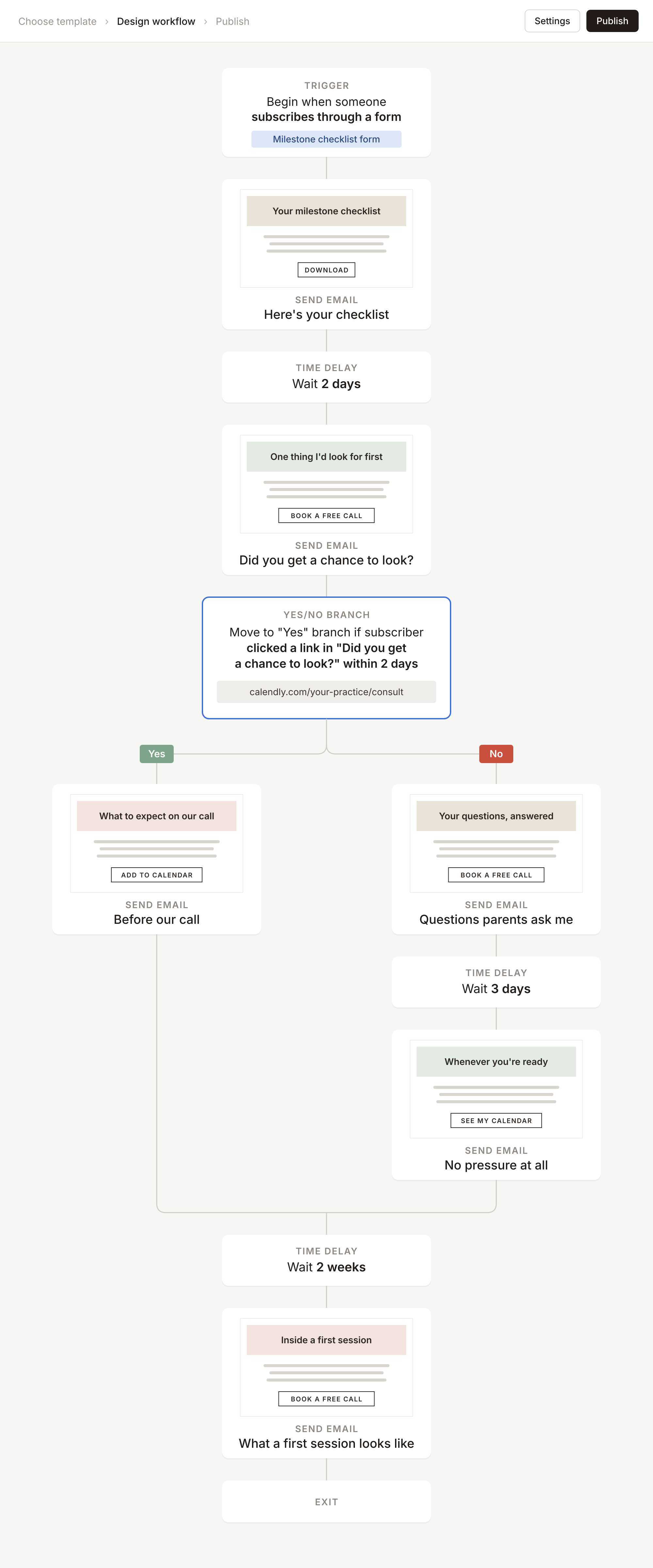
Trigger: Begin when someone subscribes through your free resource form.
Email 1, sent immediately: "Here's your checklist." The download link, two or three sentences on who you are and who you help, and a line letting them know you'll check in. Short and personal. This one email takes care of the 42-hour problem.
Time delay: wait 2 days.
Email 2: "Did you get a chance to look?" One practical tip they can use this week, and a button to book a free call.
Yes/No branch: did they click the booking link within 2 days? This is the part that makes the workflow feel personal instead of robotic. Flodesk's Yes/No branch can check whether someone clicked a specific link in a workflow email, and the timeframe is built into the branch, so you don't need a separate delay before it. Anyone who clicks moves down the Yes path right away. Anyone who hasn't clicked when the 2 days are up moves down the No path.
Yes path: "Before our call." What you'll ask, how long it takes, and that they don't need to have it all figured out before they talk to you.
No path: "Questions parents ask me." Your FAQs about fit, cost, and timing, plus the booking link. Then wait 3 days and send "No pressure at all," a plain-text check-in from you: "If now isn't the right time, that's okay. Here's my calendar whenever you'd like to talk."
The paths rejoin. In Flodesk, both paths automatically come back together after a Yes/No branch unless you add an Exit step inside one, so everyone lands in the same place: your nurture emails.
Nurture: one email every two weeks. This is where the educational emails from the section above live, like "What a first session looks like." Each one teaches something useful and ends with one invitation to book.
The call and the yes happen outside the workflow, with you. Decide ahead of time how a family leaves this sequence once they start services, so nobody gets a "still thinking about it?" email after their first session.
What should automated follow-up emails for clinicians say (and not say)?
They should sound like you would on a first phone call and they should never include clinical advice. A few rules I hold to:
Keep your form non-clinical. Name, email, child's age range, what kind of support they're looking for, and how they heard about you. Don't collect diagnoses, symptoms, or history in a marketing tool. That belongs in your secure intake system.
Write from your own name, in first person. "Hi Sarah, here's the checklist I mentioned" lands very differently than "Thank you for contacting XYZ Pediatric Therapy."
One ask per email. Book the call. That's it.
Don't promise outcomes. Describe the problem, your unique approach, and who you work best with, and let the call do the rest.
Make the "not right now" email kind. A parent who feels pressured is less likely to come back. A parent who feels respected has a reason to.
How much does Flodesk cost if my list keeps growing?
Flodesk has two plans, Unlimited Email and Unlimited Everything, and both include unlimited subscribers and unlimited emails. Your price stays the same however big your list gets and however often you email. Unlimited Email: With a monthly subscription, it's $46/month. With an annual subscription, pay $456 for the year, which works out to $38/month, a 17% savings over a monthly subscription (save $96 over 12 months). It includes unlimited subscribers, unlimited emails, unlimited forms, and unlimited workflows. Unlimited Everything: With a monthly subscription, it's $99/month. With an annual subscription, pay $948 for the year, which works out to $79/month, a 20% savings over a monthly subscription (save $240 over 12 months). It adds unlimited checkouts with payment plans, subscriptions, and buy now pay later, plus three seats (including the account owner).
For a practice, this matters because every parent who downloads your resource stays on your list. The family who said "not right now" two years ago is still someone you can nurture, and keeping them doesn't push you into a higher price.
What should I do this week?
Test your own follow-up. Download your own free resource or submit your contact form tonight, and see when you hear back and what you hear.
Pick (or make) one free resource. One page is plenty, as long as it answers a question parents already ask you.
Write Email 1. The download link, who you are, and that you'll check in. Trigger plus Email 1 is enough to start, and that alone puts you ahead of most of the practices in those studies.
List the three questions you answer on every consult call.
Add the Yes/No branch and the "no pressure" email once the first two are running.
If you want to build this in Flodesk, you can start here: [GET 25% OFF].
Disclosure: I'm a Flodesk Partner. If you sign up through my link, I earn a commission at no extra cost to you. I use Flodesk in my own business and love it!
Sources
Oldroyd, McElheran, and Elkington, "The Short Life of Online Sales Leads," Harvard Business Review (2011): https://hbr.org/2011/03/the-short-life-of-online-sales-leads
